Tag: Organization Design

  • Design Thinking: A Human-Centered Approach to Innovation

    Design Thinking: A Human-Centered Approach to Innovation

    Design Thinking: A Human-Centered Approach to Innovation

    Design thinking is a creative problem-solving process that focuses on understanding people’s needs. It’s a way to come up with innovative solutions by thinking from the user’s perspective.

    Imagine it like a toolbox with empathy, creativity, and experimentation to solve problems in new ways. That’s the essence of Design Thinking, a powerful approach to innovation that is changing the way businesses operate. It’s not just about creating fancy products or sleek designs; it’s about understanding the core needs of people and crafting solutions that truly make a difference.

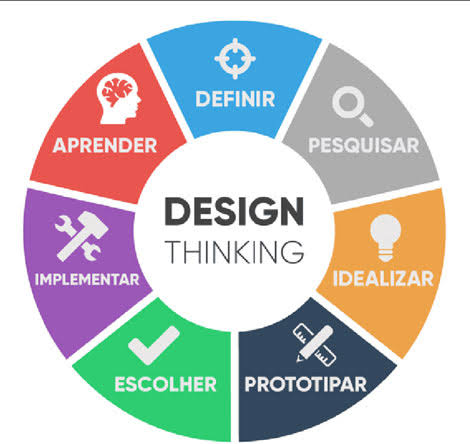
    Design thinking goes beyond traditional problem-solving methods. It throws out the rigid rulebook and embraces a more iterative and user-centric approach. Here’s how it works:

    • Empathy is at the Heart: The process starts by developing a deep understanding of the people you’re designing for. This involves user research, observation, and even co-creation sessions to uncover their needs, desires, and pain points.
    • Unleashing Creativity: Once you understand the user, it’s time to brainstorm a wide range of solutions. Design thinking encourages wild ideas and out-of-the-box thinking. The goal is to generate as many possibilities as possible without judgment.
    • Prototyping and Testing: Forget grand plans and lengthy development cycles. Design thinking emphasizes creating quick and low-fidelity prototypes – think sketches, mockups, or even role-playing – to test your ideas with real users. This allows you to gather feedback early and iterate on your designs before investing heavily in development.
    • Embrace Iteration: Design thinking is not a linear process. It’s a continuous loop of learning, testing, and refining. Based on user feedback, you’ll constantly improve your ideas until you land on a solution that truly meets their needs.

    This human-centered approach is what makes design thinking so powerful. By prioritizing empathy and understanding the people you’re designing for, you’re more likely to create solutions that are not only innovative but also truly impactful.

    Design thinking can be applied to a wide range of challenges, from developing new products and services to revamping internal processes and improving customer experiences. So, the next time you’re facing a complex problem, ditch the traditional methods and embrace the power of design thinking. You might just surprise yourself with the innovative solutions you can uncover.

  • Herbert Simon and the Attention Economy concept

    Herbert Simon and the Attention Economy concept

    Herbert Simon was a famous North American economist, winner of the Nobel Prize and an important author in the field of administration, with the book Comportamento Administrativo being one of his main works.

    He is sometimes considered among scholars of his work as a kind of “mathematical sociologist” – a definition that he himself seemed inclined to accept – due to the fact that his attempts to solve sociological problems always tended towards logical demonstration, the analysis of statistical data and mainly a critical view of the way scientists in general deal with the information factor, with information technology being the object of some of their most important studies.

    We have, for example, in the conference “Designing Organizations for an information-rich world”[1], from 1971, his important concept of Attention Economy enshrined in the following explanation: “An era rich in information causes a scarcity of what it consumes. And what it consumes is obvious, it is the attention of its receptors.” (p. 40)

    An enormous range of information creates a poverty of attention and a need to allocate it efficiently among the overabundance of information sources that may consume it.

    He considers that whether a high-capacity information system, such as a computer for example, will be part of the solution to the overabundance of information, or part of the problem, depends on the distribution of its attention between four classes of activities: listening, allocating, thinking and speak.

    It will be part of the solution in an organization if it absorbs more information than it produces, if it “listens” and “thinks” information more than it speaks. (p. 42). To cite just one of the many considerations about the Attention Economy issue that this study raises.

    Nowadays, a huge range of professionals such as data scientists, advertisers, marketing specialists, entrepreneurs in general, can find in Simon’s studies a conceptual basis to reflect on entire panoramas of the information age, such as the transition that occurred from web 1.0 to 2.0, as well as from 3.0 to the imminent 4.0, in addition to topics such as SEO (search engine optimization), mobile application development optimization, marketing strategies for social networks, etc.

    “In a world rich in knowledge, progress is not in the direction of reading and writing information or allocating more of it. Progress is toward extracting and exploring patterns so that less information needs to be read, written, or allocated. Progress depends on our ability to develop better and more powerful thinking programs for man and machine” (p. 46-47).

    Herbert Simon

    What have you done to advance your personal knowledge, or that exercised within the scope of your organization or professional activity?

    Reference:

    1. SIMON, Herbert. Designing Organizations for an Information-Rich-World. Balti-more, MD: The Johns Hopkins. Press, 1971. Access em: Dec/18